
Smart Education
The future of humans
Our vision Smart city as a holistic ecosystem
At the highest level, a Smart Campus links devices, applications, and people to deliver two key value propositions: enabling new experiences and improving operational efficiency.
A Smart Campus starts with ubiquitous, reliable wired and wireless connectivity, indoors and out. However, while that kind of connectivity may once have been a goal in itself for many colleges, it’s just the beginning of a Smart Campus. When all of the people, devices and applications on campus share a common technology infrastructure, they can interact with each other to enable experiences and efficiencies that weren’t possible before.
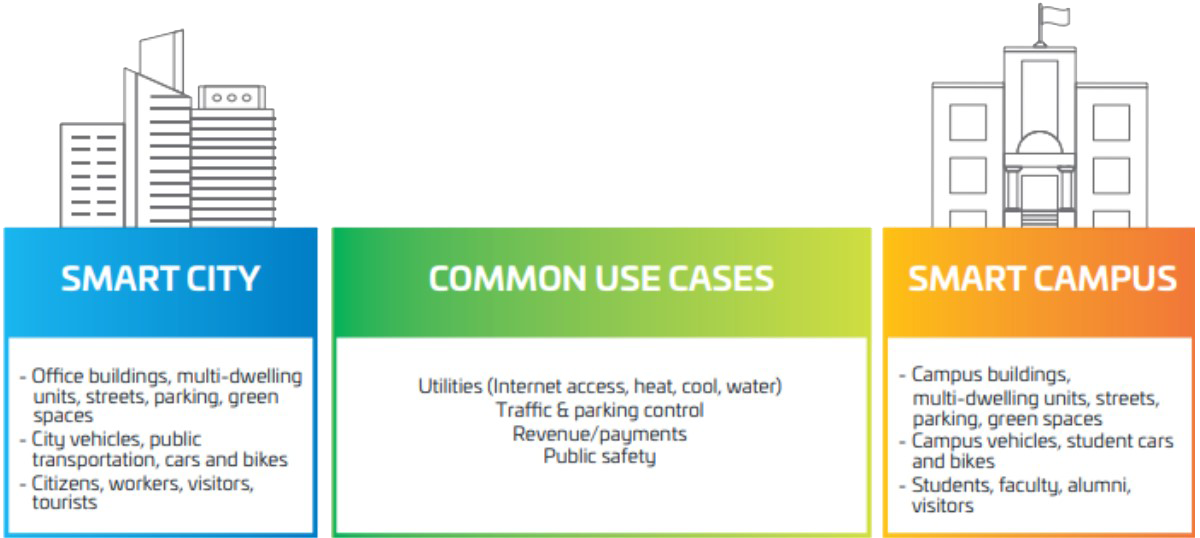
In fact, cities and campuses share many of the same goals. They’re both looking to attract people and investment in their communities. They’re seeking to create services and applications that improve the lives of citizens/students and keep them safer. And, they’re looking to stand out from the crowd by demonstrating innovation and leadership.
Let’s take a closer look at some of the areas where Smart Campus innovations can transform the campus experience for students, faculty, staff and visitors
Living:
The first facet of a Smart Campus lifestyle—and the most important pre-requisite—is providing students with a true home-away-from-home connectivity experience.
Applications:
– Smart ID cards/smart payments: student ID payment systems to integrate with credit and debit cards, and mobile payments. Integrate Smart ID cards with student information systems to automate and digitize attendance, voting, bursary distributions and even access to residence halls and school facilities.
– Smart buildings: Maintain student safety and comfort while reducing power. Connect heating, air conditioning, ventilation and safety equipment. Reduce power consumption and carbon footprint while making buildings more responsive to the people living, working and learning in them. Link building control sensors with analytics and location-based services to capture new insights about how people use the space—and make better investment and renovation decisions.
– Smart lighting: Improve student safety and campus aesthetics. Monitor and collect information on parameters such as presence and ambient light. Use this information in real time to adjust the color, temperature and intensity of indoor and outdoor lighting to reduce energy consumption and improve safety with a well-lit and inviting campus.
– Smart transit and parking: Real-time views of parking availability and traffic conditions help students arrive to class on time. Connect campus buses, bike shares and vehicles to provide real-time location and arrival information to students’ smartphones. Reduce traffic congestion by making it easy for people to find, reserve and wirelessly pay for parking.
– Real-time location services: make it easy to navigate and take advantage of campus life. Provide digital kiosks with interactive maps of campus facilities and services. Offer smartphone apps that trace a student or visitor’s path to their destination..
– Personal networks: Give students in residence halls secure personal networks just like they have at home. Let them see and easily connect with their stuff—gaming consoles, printers, streaming media devices—and only their stuff in seconds.
Learning:
On a Smart Campus, mobile technologies and applications free educators to rethink how they deliver learning. Teachers can repurpose class spaces to fit the lessons, students and faculty can share or cast the screens of their personal devices easily—without worrying about network or power cabling.
Security:
Video surveillance: traditional closed-circuit security cameras require physical connections to a switch—making deployments expensive and, in some outdoor areas, almost impossible. On a Smart Campus, anywhere it is a power source, it can deploy a smart IP video camera and use wireless meshing to connect it. Video surveillance indoor & outdoor areas, hundreds of meters from the core network.
Smart locks and access control: connected locks combined with other Smart Campus systems—smart ID card readers, video surveillance, perimeter controls – can monitor every individual coming and going at all times. Behavior-based alarms to alert campus security if someone tries to enter a building during off hours or even if a door has been left open. In residence halls, verify that everyone entering the building at night is actually a resident.
Tracking assets: combined ubiquitous wireless coverage with location-based services to track anything moving across campus. Attached Bluetooth beacons to projectors, TV screens, lab equipment and vehicles, and pinpoint their precise location on campus. Geofencing to receive alerts if an asset moves outside a given area.
Tracking people: smart campus ID cards to track the location of students in a building during an emergency evacuation.Connected medical alert wristbands that alert responders to the precise location of a student having a seizure or other medical emergency.
Security situations backed by our technology solutions: How could a Smart Campus respond to someone trying to break into a residence hall at night?
1. Motion detectors identify movement at a place and time where no one should be.
2. Wi-Fi locks recognize that someone is attempting entry without proper authorization.
3. Connected lights snap on illuminating the entryway.
4. Smart surveillance cameras automatically turn to capture video.
5. If the intruder is a student or employee with a smart campus ID card, the system immediately recognizes who it is.
6. An alert is sent to campus security with all the relevant information and a real-time video feed so they can respond appropriately
– Location intelligence supports students and staff walking alone to evening classes.
– Smart locks, geofencing, and smart ID cards provide convenient access control.
– Digital signage and kiosks alert people and help evacuate areas quickly.
– Smart IP video cameras send data and alerts so administrators can secure locations.
Student Services:
- Find parking
- Real-time bus, bike share transit info
- Interactive digital kiosks
- Wayfinding applications
Features:
- A single integrated application that automates all processes on the campus for better efficiency and lower costs
- Smart Card and Biometrics based access
- Secure role based access – control who should see what information
- Detect water leaks or faulty appliances to address operational deficiencies proactively
- Rich feature set of modules covering – Admissions, Fees, Academics, Examinations, Library, Hostel, HRMS and Payroll to name a few
- Dynamic report dashboard – easily create or view different reports
- Provides automation of everyday functionalities like – TimeTable, Attendance, Book Issue / Return, Dues Collection etc.
- Provides the Principal and Management more control over the operations of all the processes in the campus and facilitates better informed decisions
- Students & Staff can view their personal, financial and academic information using the smart card within the campus
- Facilitates the academic departments to configure the academic calendar and lesson plan that helps them monitor academic progress during the entire term
- Mobile and contactless payment options
- Real-time occupancy systems
- Direct visitors to open parking spaces and provide campus mapping technologies.
- Smart energy: by connecting buildings and utilities to smart technologies, administrators can reduce overall costs. For instance, automation tools free up administration time and allow higher education officials to redirect resources.
You can also automate temperature, lighting & utility use by adding sensors to
HVAC systems and more. With a connected environment, you can identify
maintenance needs and efficiently deploy workers to perform regular
maintenance from changing light bulbs before they burn out to other
interventions.